Boiler Water Testing: If You’re Not Monitoring You’re Not Managing
Steam boilers are often described as the heart of a manufacturing site. They provide the heat, energy and process continuity that many businesses depend on every day. But behind every reliable steam system is something far less visible, yet absolutely critical: effective boiler water testing.
Testing boiler water, feedwater and condensate is not simply a routine box-ticking exercise. It is one of the main ways a site can confirm that the boiler is being operated safely, efficiently and within the correct water-side control limits. More importantly, it provides early warning when something is starting to go wrong.
However, taking a sample and producing a number is only the first step. The real value comes from understanding what that number means, what risk it represents, and what action is required.
Why boiler water testing matters
Water may look harmless, but every water source contains impurities that can damage a boiler system if they are not correctly controlled. Hardness, oxygen, dissolved solids, alkalinity imbalance, iron, copper, carbon dioxide, oil, process contamination and poor condensate quality can all contribute to serious operational problems.
The consequences can include:
- Scale formation on heat transfer surfaces
- Oxygen pitting and corrosion
- Sludge accumulation
- Poor heat transfer and increased fuel use
- Priming, foaming and carryover
- Water hammer in steam and condensate lines
- Damage to steam traps, valves and process equipment
- Boiler lockouts and unreliable operation
- Premature tube failure
- In severe cases, dangerous overheating or catastrophic failure
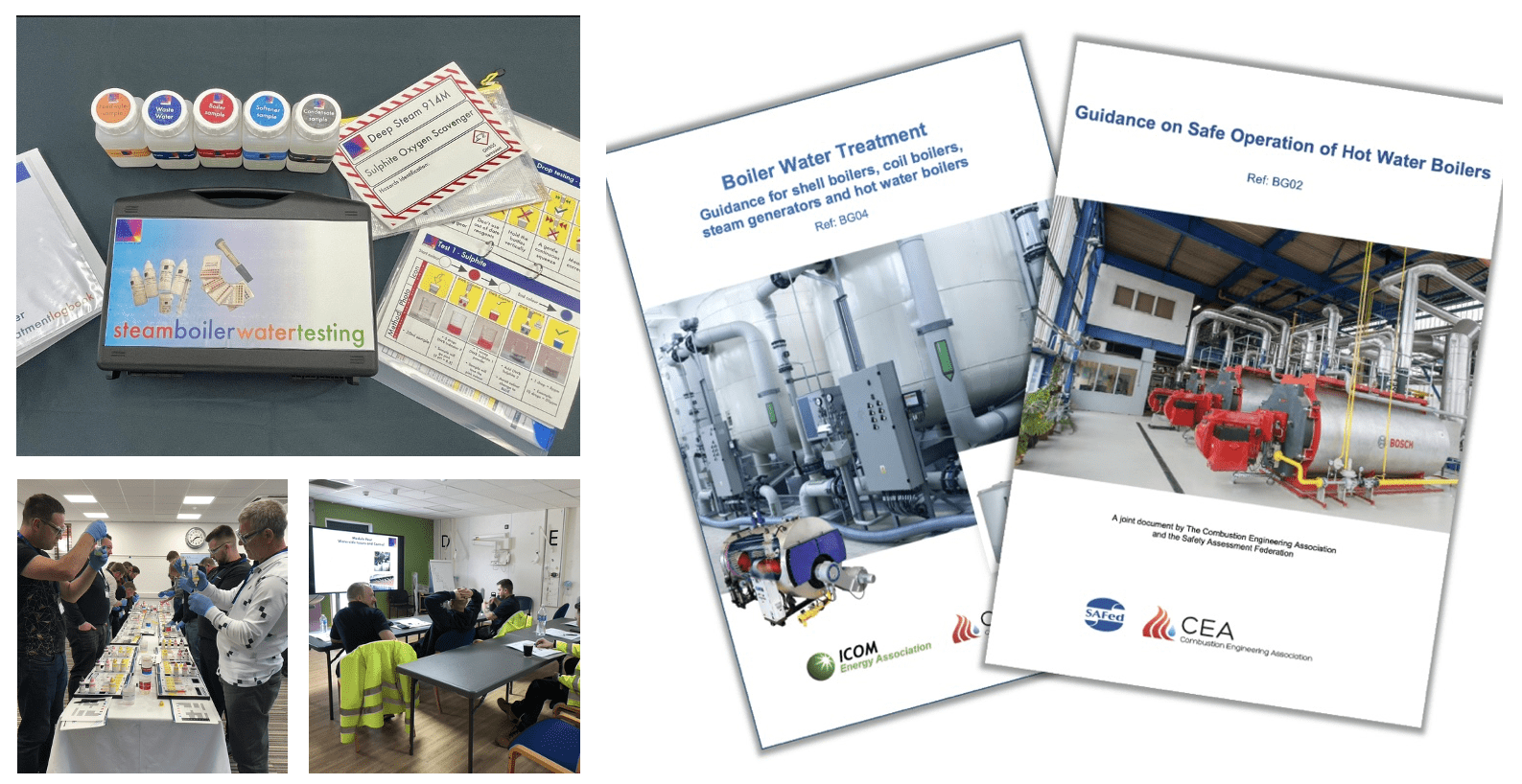
BG04 is very clear on the significance of water treatment, stating that boiler failures can and do occur, with common causes including sludge accumulation, corrosion and overheating caused by scale or other deposits. It also notes that poor or inadequate water treatment has been shown to be the cause of more than 95% of boiler failures.
This is why regular testing is essential. It allows the site to verify whether the water treatment programme is working, whether the pre-treatment plant is performing correctly, whether condensate is suitable for return, and whether the boiler is being protected from scale, corrosion and carryover.
Testing is part of safe boiler management
Boiler water testing is not separate from boiler safety. It is part of it.
BG01 identifies proper treatment and monitoring of feedwater and condensate as part of safe and efficient boiler operation, specifically to minimise corrosion and scale and to avoid carryover of water with the steam, which can cause water hammer and other issues.
HSE guidance also highlights routine testing of feedwater quality as essential to ensuring a boiler continues to operate safely, reliably and efficiently. Test results should be recorded, compared against required values, and include any corrective action taken where necessary.
This is the key point: testing is not complete when the test kit is put away. Testing is only complete when the result has been interpreted, recorded, compared with the correct control range, and acted upon where required.
What should be tested?
The exact test regime should be defined by the boiler type, pressure, water treatment programme, make-up water quality, condensate return, process risk and the site-specific BG04 Boiler Water Treatment Risk Assessment.
However, routine testing commonly includes:
- Softener hardness
- Feedwater hardness
- Boiler water pH
- Feedwater pH
- Condensate pH
- Boiler alkalinity
- Oxygen scavenger reserve
- Total dissolved solids, or conductivity
- Chloride
- Phosphate, where relevant
- Sulphite, tannin or alternative treatment reserve, where relevant
- Iron and copper, where required
- Condensate contamination indicators
- Temperature of the hotwell or feed tank
- Chemical stock levels and dosing equipment operation
BG01 states that in-house routine testing is expected to include oxygen scavenger reserve, alkalinity, pH, hardness checks of the softening plant, feed tank and boiler, total dissolved solids within the boiler, and appropriate condensate tests, alongside other tests determined by risk assessment.
The danger of testing without understanding
A common weakness in boiler houses is not the absence of testing. It is testing without competence.
A site may have test kits, log sheets and chemical treatment in place, but if the person carrying out the test does not understand the significance of the result, the risk remains. A hardness test showing breakthrough from a softener is not just a number. It may mean scale-forming salts are entering the feed tank. A low oxygen scavenger reserve is not just a failed test. It may mean the boiler is exposed to oxygen pitting. A sudden rise in condensate conductivity is not just an anomaly. It may indicate process contamination entering the return system.
The critical questions are:
What does the result mean?
Is it within the agreed control range?
Is it a sampling or testing error?
Does the result indicate a developing plant fault?
What immediate action is required?
Who needs to be informed?
Should the boiler continue to operate?
Does the Written Control Scheme need to be reviewed?
This is where training becomes essential.
Training turns testing into control
A trained operator does not simply carry out a test. They understand why the test is required, how to obtain a representative sample, how to avoid contamination, how to use the test equipment correctly, how to interpret the result, and when to escalate.
BG01 recommends that boiler operators and managers receive training appropriate to the equipment and duties they are expected to perform. It specifically identifies feedwater and boiler water analysis as a required training topic and encourages enhanced training in steam boiler water testing in accordance with BG04.
BG04 is even more direct, stating that only personnel who have been formally trained and deemed competent in boiler water treatment should be involved in changes that affect water chemistry. It also states that the management and recording of boiler data for both the waterside and steam side are critical within the programme.
This matters because boiler water chemistry is not isolated from plant operation. Steam demand, condensate return, feed tank temperature, deaeration, blowdown, chemical dosing, softener performance and process contamination all interact. Without training, it is easy to treat a symptom rather than identify the cause.
Compliance responsibilities cannot simply be outsourced
Many sites rely on water treatment contractors, and specialist support is an important part of good boiler management. But the legal responsibility for safe operation remains with the user or owner.
BG01 states that third parties can assist with compliance, but the overall legal responsibility remains with the user or owner and cannot be contracted out.
This means site personnel still need sufficient understanding to manage the programme, challenge abnormal results, ensure actions are completed and maintain suitable records. A monthly service visit alone is not a substitute for daily competence on site.
The boiler operator’s duties may include carrying out recommended water quality tests, routine water treatment, recording results and making adjustments where necessary in accordance with established standards and guidance. BG01 also notes that this should be in addition to any testing contracted out to a water treatment specialist.
Good records are evidence of control
A boiler water log sheet is more than a historical record. It is evidence that the system is being managed.
Good records should show:
- The date and time of testing
- The person carrying out the test
- The sample point
- The test result
- The required control range
- Any corrective action taken
- Any escalation or specialist advice
- Follow-up confirmation that the issue was resolved
Without this, a site may struggle to demonstrate that it understood the condition of the boiler system and took appropriate action when required.
Poor records often hide repeated minor deviations that later become major failures. Good records allow trends to be seen early: gradual hardness leakage, falling sulphite reserve, increasing condensate iron, rising boiler TDS, declining feed tank temperature or recurring low alkalinity.
In boiler water treatment, trends are often more valuable than isolated results.
Testing protects safety, efficiency and reliability
Correct testing and interpretation help prevent failures, but they also improve efficiency. Scale acts as an insulator. Even a relatively thin layer can reduce heat transfer, increase fuel consumption and raise metal temperatures. BG04 explains that boilers and steam generators containing scale require more heat input to achieve the same steam output, increasing energy consumption and operating cost.
In a commercial environment where energy, carbon and downtime all matter, poor water treatment is not just a technical issue. It is a business risk.
Effective testing supports:
- Lower fuel consumption
- Reduced chemical waste
- Reduced blowdown losses
- Better condensate return
- Fewer boiler lockouts
- Longer asset life
- Improved statutory inspection outcomes
- Stronger compliance evidence
- Reduced risk of unplanned downtime
The right question is not “are we testing?”
Many boiler houses can say they are testing. The better question is:
Are the right people testing the right things, at the right frequency, in the right way, against the right control limits — and do they know what action to take when the result is wrong?
That is the difference between simply collecting numbers and actively managing risk.
A robust boiler water treatment programme should include:
- A BG04 Boiler Water Treatment Risk Assessment
- A site-specific Written Control Scheme
- Clear test frequencies and control limits
- Suitable sampling points
- Correct test equipment
- Competent, trained personnel
- Defined escalation procedures
- Regular specialist review
- Trend analysis
- Documented corrective actions
- Refresher training when systems, personnel or operating conditions change
Conclusion
Boiler water testing is one of the most important routine tasks in a steam boiler house. But testing alone is not enough.
The safety and reliability of the system depend on competent people understanding the results, recognising when something is wrong, and taking the correct action quickly. A boiler water sample can warn of scale, corrosion, contamination, carryover or treatment failure — but only if the person reading the result knows what they are looking at.
In steam boiler water treatment, the test result is not the end of the process. It is the start of the decision.
That is why training, competence and specialist support are not optional extras. They are fundamental parts of safe, efficient and compliant boiler operation.