When the Process Contaminates the Boiler: The Hidden Risks in Condensate Return
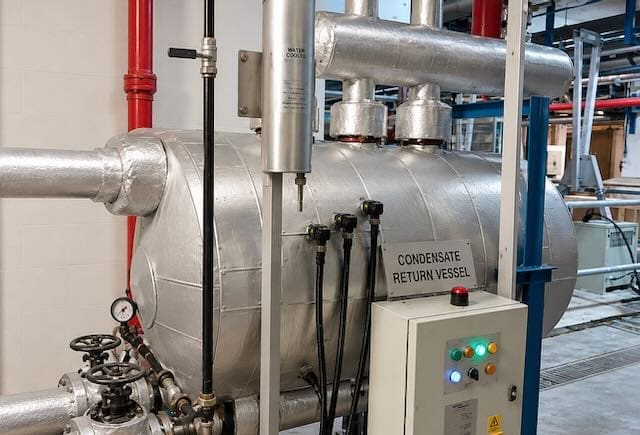
Condensate recovery is one of the most effective ways to improve steam system efficiency. But what happens when the water returning to the boiler house is no longer clean?
In an efficient steam system, condensate is a valuable resource.
Once steam has transferred its heat to a process, much of it condenses back into water. Where the process and system design allow, this condensate can be returned to the boiler house and reused.
The benefits are significant.
Returned condensate is usually hot and contains relatively low concentrations of dissolved minerals compared with incoming make-up water.
Recovering it can reduce water consumption, external water treatment demand, energy use and the amount of treatment chemical required.
For these reasons, improving condensate recovery is frequently seen as an attractive efficiency measure.
However, there is an important qualification.
Condensate is only an asset when its quality is suitable for reuse.
If contaminants enter the return system, the same network designed to improve efficiency can become a route for introducing potentially damaging substances into the boiler.
How Does Condensate Become Contaminated?
Steam is used across a wide range of industrial processes.
It may provide heat through coils, heat exchangers, jackets, calorifiers or other equipment.
In many applications, steam and the product being heated are intended to remain physically separated.
However, that separation depends on the integrity of the equipment.
A damaged heat exchanger, leaking coil, or failed internal component can create a route for process materials to enter the condensate system.
The direction of leakage depends on the relative pressures and operating conditions.
Contamination may be continuous or intermittent, occurring only during certain production cycles or when equipment is shut down.
This makes it particularly difficult to identify.
A condensate sample collected during one part of the day may appear satisfactory, while contamination develops during another period of operation.
The absence of a problem in a single sample does not necessarily confirm that the condensate system is consistently clean.
Different Processes, Different Risks
The nature of potential contamination depends on the site.
In food and beverage production, leakage might introduce organic materials, sugars, fats or cleaning chemicals into the condensate return.
In laundries and textile processes, the substances of concern may include detergents, surfactants or other process chemicals.
In manufacturing environments, contamination could involve oils, solvents or substances associated with the production process.
Even relatively small quantities of certain contaminants can cause problems.
Some substances may increase the tendency for boiler water to foam. Others may affect pH, interfere with chemical treatment or contribute to deposition.
Oil contamination, for example, can interfere with heat transfer when deposits form on boiler surfaces.
The significance of contamination depends on the substance involved, its concentration, the boiler operating conditions and the characteristics of the treatment programme.
This is why suspected process contamination requires investigation rather than assumptions based solely on routine boiler water results.
Why Contamination Can Be Difficult to Detect
Many boiler water monitoring programmes focus appropriately on parameters such as pH, alkalinity, hardness, conductivity and chemical treatment reserves.
These are essential measurements.
However, not every process contaminant produces an obvious or immediate change in these parameters.
Some organic materials may enter the system without creating a proportional increase in conductivity.
Oil contamination may not initially produce a dramatic change in routine chemical results.
Other contaminants may cause an unexpected shift in pH or chemical demand, but those changes are not necessarily unique to contamination.
As a result, the normal monitoring programme may indicate that something has changed without immediately identifying the cause.
This is where an understanding of the site processes becomes particularly valuable.
The water treatment specialist should know what substances could realistically enter the condensate system and which additional analytical techniques might be appropriate.
What Happens When Contaminated Condensate Returns to the Boiler?
The consequences can vary considerably.
One potential problem is foaming.
Under unsuitable conditions, contaminants can affect the surface behaviour of boiler water, increasing the likelihood of foam formation and potentially contributing to carryover.
Carryover occurs when boiler water becomes entrained in the steam leaving the boiler.
This can transport treatment chemicals and dissolved or suspended materials into the steam distribution network.
Depending on the application, this can affect steam quality and downstream equipment.
Other contaminants may contribute to deposits on heat transfer surfaces, reduce treatment effectiveness or create conditions that encourage corrosion.
The exact outcome depends on the contaminant and the system.
Importantly, the damage may not be immediate.
A low-level contamination problem can develop over time, potentially creating deposits or corrosion-related issues that are only recognised during inspection or following an equipment failure.
The Feedwater Tank Is Often the First Point of Contact
When contaminated condensate returns to the boiler house, it commonly enters the feedwater tank.
Here, it may mix with make-up water and condensate from other parts of the site.
This creates a particular challenge.
Once contaminated condensate is combined with otherwise clean water, it becomes more difficult to establish where the contamination originated.
The feedwater tank may show the effect of a problem without revealing its source.
Changes in water appearance, unusual odours, surface films, unexpected conductivity trends or changes in chemical demand may provide warning signs.
However, none of these observations is sufficient on its own to identify a particular contaminant.
A structured investigation may require sampling individual condensate returns before they combine.
This can help determine whether the problem is associated with a particular process, item of equipment or period of operation.
Should All Condensate Be Returned?
Maximising condensate recovery is generally desirable from an energy and resource perspective.
But it should not take priority over protecting the boiler and maintaining appropriate steam quality.
Where condensate presents a credible contamination risk, suitable monitoring, isolation or diversion arrangements may be necessary.
The correct approach depends on the process, the potential substances involved and the design of the condensate system.
For some installations, continuous monitoring of a relevant indicator may support an automatic diversion arrangement.
For others, periodic sampling, dedicated returns or a more detailed process risk assessment may be appropriate.
A single conductivity measurement is not a universal contamination safeguard.
Some contaminants are poorly detected by conductivity, while others may require specific testing or monitoring methods.
The selected protection strategy should be capable of detecting the credible hazards associated with the particular process.
What If Contamination Is Suspected?
Where contamination is suspected, the priority should be to prevent unsuitable water from continuing to enter the boiler while the issue is investigated.
This may involve isolating or diverting a suspect condensate return in accordance with established site procedures.
The investigation should consider:
- Which processes and heat exchangers are connected to the condensate system.
- Whether contamination is associated with particular production cycles.
- Any recent maintenance, cleaning or process changes.
- Whether abnormal results are present in specific return lines.
- What substances could be entering the system.
- Whether the boiler water treatment programme has been affected.
The boiler manufacturer and competent water treatment specialist should be involved as appropriate, particularly where the contamination could affect safe operation or equipment integrity.
It may also be necessary to assess the boiler and associated equipment before normal operation is resumed.
The response should reflect the nature and seriousness of the suspected contamination.
Looking Beyond the Boiler House
One of the challenges with condensate contamination is that the root cause may be a considerable distance from the boiler.
The engineering team responsible for the boiler may have little direct involvement with the production equipment introducing the problem.
Equally, process operators may not realise that a small leak within their equipment could affect the wider steam system.
Effective prevention therefore requires communication between teams.
Production, maintenance, boiler operations and water treatment specialists all have a role in identifying potential contamination routes and responding to unusual conditions.
When new process equipment is connected to the steam system, the implications for condensate quality should be considered from the outset.
Recover Heat Without Recovering Risk
Condensate recovery can deliver substantial efficiency benefits.
But the value of returned condensate must be assessed alongside its quality.
A programme that concentrates entirely on recovering the maximum quantity of water may overlook the consequences of introducing unsuitable substances into the boiler.
Equally, unnecessarily discarding clean condensate wastes energy and water.
The objective is to recover as much suitable-quality condensate as practical while maintaining appropriate safeguards against contamination.
At Deep Water Blue, we take a whole-system approach to boiler water treatment, recognising that problems affecting boiler reliability may originate far beyond the boiler house.
If your site operates complex condensate returns, or if unexplained changes in boiler water quality have been difficult to trace, reviewing the condensate system may provide important answers.