
Pretreatment Plant for Boilers: The First Line of Defence — And a Critical Safety Risk if It Fails
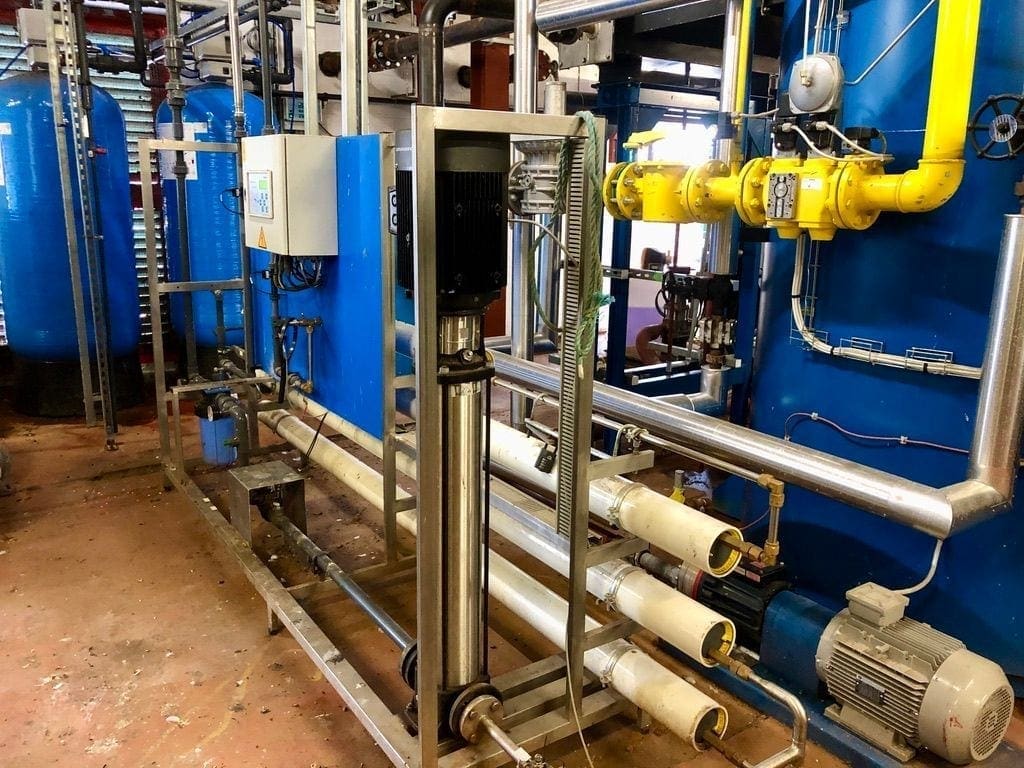
When discussing boiler water treatment, most attention is placed on internal chemistry within the boiler itself.
However, the real protection begins much earlier — with the pretreatment plant.
Systems such as water softeners, reverse osmosis (RO) units, dealkalisation systems, and filtration act as the first line of defence against scale, corrosion, and efficiency loss in steam systems.
Without effective pretreatment, the integrity of the entire boiler system is at risk.
Why Pretreatment Plant Is Critical for Boiler Safety
Industry guidance highlights the importance of correct water treatment:
- BG04 states that poor or inadequate water treatment is responsible for over 95% of boiler failures
- INDG436 warns that incorrect water treatment can lead to scaling, corrosion, and even premature or catastrophic failure
While these risks are well understood from a technical perspective, there is another equally important aspect that is often overlooked — the physical failure of pretreatment equipment itself.
What Happens When Pretreatment Plant Fails?
Pretreatment plant failure can have immediate and serious consequences.
For example, a failure of a water softener vessel can result in resin discharge within the boiler house — a scenario that introduces both operational and safety risks.
Operational Consequences
- Immediate loss of hardness control
- Hardness breakthrough to the steam generator
- Rapid scale formation within the boiler
- Increased risk of overheating and equipment damage
- Potential non-compliance with your Written Scheme of Examination (WSE)
The Hidden Safety Risk: Resin Spill Hazards
One of the most underestimated dangers is the physical hazard created by ion exchange resin.
When released, resin beads behave like ball bearings on smooth surfaces.
This creates an extreme slip hazard, particularly in boiler houses where conditions already include:
- Hot surfaces and pipework
- Blowdown discharge lines
- Pressurised systems
- Moving equipment
In this environment, a simple loss of footing can quickly escalate into a serious incident.
Beyond Water Treatment: A Wider Safety and Compliance Issue
A pretreatment plant failure is not just a water quality problem — it has broader implications across:
- Workplace safety management
- Emergency response planning
- Risk assessments under the Management of Health and Safety at Work Regulations (MHSWR)
- RIDDOR reporting considerations in the event of injury
This elevates pretreatment plant from a maintenance concern to a critical safety and compliance component.
Pretreatment Plant as a Safety-Critical System
Pretreatment equipment should not be viewed as simple water softening infrastructure.
It is:
- A safety control measure
- An asset protection system
- A driver of energy efficiency
- A compliance-critical element within your BG04 risk assessment
Key Questions to Ask About Your Pretreatment Plant
To strengthen your boiler system resilience, consider:
- When was your softener vessel last inspected internally?
- Is it operating within safe pressure and temperature limits?
- Are operators trained to identify early signs of failure?
- Is resin loss or vessel fatigue included in your risk assessment?
Prevention Is Always Better Than Reaction
Once hardness enters the boiler, you are already reacting to a problem.
And once resin reaches the floor, you are managing an immediate safety incident.
Strong boiler performance — and safe boiler house environments — depend on robust pretreatment plant management.
Strengthening Your Boiler Risk Assessment
If you are responsible for a steam system, now is the time to:
- Review your pretreatment plant condition and maintenance strategy
- Revisit your BG04 Boiler Water Treatment Risk Assessment
- Ensure your controls address both technical and physical failure risks
At Deep Water Blue, we support organisations in assessing and strengthening their boiler water treatment and pretreatment systems, helping to improve safety, compliance, and long-term reliability.
Because effective water treatment starts before the boiler — and failure at this stage can impact far more than efficiency.