Board-Level Steam Risk: Questions Every Director Should Ask
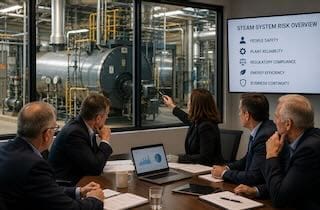
Steam systems are often treated as a boiler house issue. They sit behind closed doors, managed by engineers, operators, maintenance teams, insurers, inspectors and specialist contractors. For many organisations, the board only hears about the steam plant when there is a major capital request, an energy-saving project, a breakdown, an insurance inspection, or a production crisis.
That distance is understandable, but it can also be dangerous.
A steam boiler is not simply a utility asset. It is a pressure system, an energy centre, a production dependency, a compliance obligation and, in the wrong conditions, a serious safety hazard. It can affect people, plant, production, product quality, environmental performance, insurance, reputation and legal accountability. The risk may be managed in the boiler house, but the consequences are often felt at board level.
This article is not written for boiler operators. It is written for directors, senior managers and duty holders who may not need to know every detail of boiler chemistry, combustion controls or statutory examination requirements, but who do need to ask the right questions.
The central point is simple: steam risk should not be hidden in technical detail. It should be visible, governed and assured like any other critical business risk.
Why steam risk belongs on the board agenda
In many manufacturing, healthcare, food, beverage, pharmaceutical, paper, textile and processing environments, steam is central to production. It heats, sterilises, cooks, dries, cleans, humidifies, powers and supports processes that often cannot continue without it.
When the steam system fails, the impact is rarely limited to the boiler house. Production may stop. Product may be lost. Hygiene or sterilisation processes may be compromised. Buildings may lose heating or hot water. Contractors may be called in urgently. A temporary plant may be required. Insurance notifications may follow. Regulators may become involved. Customers may be affected.
More importantly, steam contains stored energy. A boiler failure is not just a mechanical inconvenience. It has the potential to cause serious injury, major property damage and, in extreme cases, fatality. That is why steam systems sit within a framework of legal duties, competent inspection, safe operating limits, written schemes of examination, training, maintenance, testing and risk assessment.
The board does not need to operate the boiler, but it does need to understand whether the organisation has effective control of the risk.
A useful starting question is:
Do we understand our steam system as a strategic risk, or do we simply assume it is being dealt with by someone else?
Question 1: Who is the duty holder, and is that understood?
The first board-level question is not technical. It is about responsibility.
For installed pressure systems, responsibility normally rests with the user: the employer or organisation that has control of the operation of the system. In practical terms, that means a company cannot simply outsource responsibility to an insurer, inspection body, maintenance contractor, boiler operator or water treatment provider.
Specialists can support. Contractors can advise. Competent persons can examine. Operators can test and monitor. But accountability for ensuring that the system is properly managed remains with the organisation in control.
Directors should therefore ask:
Who is the named senior person responsible for steam boiler safety and compliance?
Has a Responsible Person been formally appointed?
Is there a deputy?
Are their duties written down, accepted and understood?
Do they have the authority, budget and competence to act?
Too often, responsibility is assumed rather than assigned. The engineering manager assumes the contractor is managing it. The contractor assumes the site is reviewing the recommendations. The operator assumes senior management understands the risks. Senior management assumes the inspection regime covers everything.
Assumption is not governance.
A simple responsibility map can be powerful. It should show the duty holder, Responsible Person, deputy Responsible Person, boiler operators, maintenance personnel, contractors, water treatment provider, competent person, insurer and escalation routes. It should also show what decisions each party can make, what they must report, and where authority sits for shutdown, repairs, changes and capital expenditure.
If the answer to “who owns this risk?” is unclear, the organisation has already identified a board-level weakness.
Question 2: Are we operating within our safe limits?
Every boiler system has safe operating limits. These may include pressure, temperature, water level, heat input, flow, fuel arrangements, operating conditions, steam demand, water quality and the limits of protective devices.
The board does not need to know every set point, but it should ask whether the organisation can demonstrate that the boiler is being operated within its intended design and safety envelope.
This matters because steam systems often change over time. Production increases. Shifts change. Steam demand fluctuates. New processes are added. Old plant is removed. Condensate return arrangements alter. Automation is upgraded. Staffing levels change. Contractors change. A boiler that was suitable for the site ten years ago may now be operating under a very different demand profile.
A key board-level question is:
Has our steam demand, operating pattern or site layout changed since the boiler was installed or last formally reviewed?
This is particularly important where boilers experience rapid load swings, frequent cycling, poor feedwater control, low feed tank temperatures, unstable condensate return, or repeated alarms. These may look like operational issues, but they can also indicate a mismatch between plant design, process demand and management control.
Directors should expect evidence, not reassurance. That evidence might include operating records, trend data, burner service reports, water treatment reviews, inspection findings, maintenance history, alarm logs, blowdown records and steam demand analysis.
A boiler that is “still running” is not necessarily being operated safely, efficiently or sustainably.
Question 3: Is there a current Written Scheme of Examination, and does it reflect reality?
The Written Scheme of Examination is a core legal and safety document for relevant pressure systems. It identifies which parts of the system require examination, the type and frequency of examination, and the preparation required.
At board level, the question is not simply “do we have one?” but:
Does our Written Scheme of Examination reflect the system as it actually exists and operates today?
A Written Scheme should not be treated as a static compliance file. It may need review if there are changes to the boiler, pipework, protective devices, operating pressure, process demand, staffing, supervision, automation, maintenance arrangements or site environment.
Directors should ask:
When was the Written Scheme last reviewed?
Who certified it?
Were any recommendations raised?
Have all recommendations been closed out?
Are examination reports reviewed at senior level?
Are defects, restrictions or repeat observations tracked to completion?
A common weakness in many organisations is that inspection reports are received, filed and forgotten. That is not effective risk management. Findings from competent person examinations should be part of a visible assurance process, especially where they relate to corrosion, scale, protective devices, controls, safety valves, water level limiters, repairs, modifications or operating restrictions.
The board does not need to review every inspection report in detail, but it should receive assurance that statutory examinations are completed, findings are acted upon, and recurring issues are escalated.
Question 4: Are our people competent, or merely experienced?
Steam systems are often managed by people with many years of site experience. That experience is valuable, but it is not the same as demonstrable competence.
Competence should be role-specific, current and evidenced. Boiler operators need appropriate training for the plant they operate. Personnel monitoring alarms need to know what action to take and when to escalate. Maintenance staff need to understand the limits of their work. Contractors need to be competent for the tasks they perform. Water treatment personnel need specific steam boiler water treatment competence, not just general water treatment experience.
At board level, the question should be:
Can we prove that everyone involved in operating, testing, maintaining, monitoring and managing the steam system is competent for their role?
This includes directly employed staff, agency workers, contractors and specialist providers.
Directors should be cautious of informal training arrangements. One operator showing another how testing is done may be useful familiarisation, but it is not a robust competence programme. Training should be structured, recorded, refreshed and linked to the actual site system.
The board should ask:
Do we have a training matrix for steam system roles?
When was training last refreshed?
Has training been reviewed after plant modifications, staffing changes, incidents or out-of-specification results?
Are contractors assessed before appointment and periodically reviewed?
Do senior duty holders and Responsible Persons understand their own legal and managerial responsibilities?
Competence is not only an operator issue. If the senior person responsible for the steam system does not understand what good control looks like, they may not know when to challenge, escalate or stop the plant.
Question 5: Is water treatment being treated as a safety control?
Water treatment is sometimes viewed as a chemistry service, a cost line or a routine testing task. At board level, it should be understood as a critical safety, reliability and efficiency control.
Poor water treatment can lead to scale, corrosion, sludge accumulation, foaming, priming, carryover and water hammer. Scale can reduce heat transfer and cause overheating. Corrosion can weaken tubes, shells and condensate systems. Carryover can contaminate steam distribution systems and damage downstream plant. Water hammer can be violent and destructive.
The consequences are not limited to boiler efficiency. Water treatment failures can contribute to unsafe conditions, statutory inspection failures, unplanned outages, expensive repairs and shortened asset life.
Directors should ask:
Do we have a current boiler water treatment risk assessment?
Do we have a written control scheme for water treatment?
Are the control limits site-specific?
Are test results reviewed, trended and acted upon?
What happens when results are out of specification?
Are condensate, feedwater and boiler water all being monitored appropriately?
Do we understand the source and impact of contamination?
A board should be wary of programmes that simply collect test results without interpretation. Testing does not control risk unless the results are understood and action is taken. A log sheet full of numbers is not assurance if no one can explain what the numbers mean, whether they are within limits, what trends are developing, and what corrective actions have been completed.
Water treatment should also be linked to business performance. Excessive blowdown wastes heat, water and chemicals. Poor condensate return increases energy and treatment demand. Low feedwater temperature reduces efficiency. Steam contamination can affect process quality. In this sense, water treatment is both a safety control and an efficiency opportunity.
Question 6: Are we seeing the early warning signs?
Major failures are rarely the first sign of poor control. More often, there are warning signals that appear months or years earlier.
These might include repeated low-level alarms, unexplained water loss, rising chemical consumption, hardness breakthrough, unstable TDS, low hotwell temperature, high make-up demand, condensate contamination, corrosion products, iron or copper in returns, frequent trap failures, unexplained carryover, wet steam, poor heat transfer, repeated safety valve lifting, burner lockouts, leaking tubes, failed inspection findings, or rising fuel use.
At board level, the question is:
What are the top five steam system warning indicators we monitor, and who reviews them?
A good steam risk dashboard does not need to be complicated. It might include compliance status, overdue actions, statutory examination findings, out-of-specification water results, boiler efficiency indicators, make-up water percentage, condensate return percentage, feed tank temperature, alarm events, unplanned downtime, contractor recommendations and training status.
The important point is that technical data should be converted into management information. Directors do not need every daily test result, but they do need to know whether the system is under control.
If the only time the board hears about the boiler is when it fails, the reporting system is not mature enough.
Question 7: What would happen if steam were unavailable?
Steam failure is not only a safety issue. It is also a business continuity issue.
Many organisations have detailed plans for IT failure, power interruption, cyber incidents and supply chain disruption, yet have limited understanding of what would happen if the boiler plant was unavailable for a day, a week or longer.
Directors should ask:
Which processes stop without steam?
How quickly would production be affected?
What is the cost per hour or per day of lost steam?
Do we have redundancy?
Can a temporary plant be connected safely and quickly?
Are connection points, permits and responsibilities already defined?
Would product quality, hygiene, sterilisation or customer supply be affected?
Do insurers understand the risk profile?
This is where boiler house risk becomes enterprise risk. A steam outage may interrupt revenue, breach customer commitments, damage raw materials, create waste, compromise environmental targets and trigger emergency expenditure.
A board that understands steam dependency is better placed to make informed decisions about maintenance windows, capital replacement, standby capacity, water treatment upgrades, automation, monitoring and operator training.
Question 8: Are contractors being managed, or simply trusted?
Steam systems often rely on multiple external specialists: boiler service companies, burner engineers, water treatment providers, chemical suppliers, insurers, inspection bodies, control specialists, pipework contractors and temporary boiler providers.
Specialist support is essential, but it must be managed.
Directors should ask:
How do we assess contractor competence before appointment?
Are responsibilities clearly defined in writing?
Do contractors communicate with each other where their work overlaps?
Who reviews contractor reports and recommendations?
Are recommendations risk-ranked and closed out?
Are contractors audited?
Do we rely too heavily on one supplier’s opinion?
A common risk is fragmented accountability. The water treatment company may identify repeated condensate contamination. The maintenance contractor may replace traps. The boiler inspector may note deposits. Production may report poor heating. Each party sees part of the picture, but no one joins it together.
The board should expect the Responsible Person to coordinate these interfaces. Steam system risk does not respect contract boundaries.
Question 9: Are modifications controlled?
Many serious risks arise not from the original boiler design, but from later changes. A new process connection, altered steam main, replacement control, changed chemical programme, modified feed system, different fuel arrangement, revised staffing model, remote monitoring system or new condensate return can all affect risk.
Directors should ask:
Do we have a formal management of change process for the steam system?
Does it include technical review, risk assessment, competent person input where required, updated drawings, revised operating instructions, training and commissioning records?
Changes to steam systems should not be treated as routine maintenance unless they genuinely are routine. Even apparently small changes can alter operating conditions, protective functions, water quality, steam demand or examination requirements.
Good governance means ensuring that no one can make uncontrolled changes to a critical pressure system.
Question 10: What assurance does the board receive?
The final question is perhaps the most important:
How does the board know that steam risk is being effectively controlled?
The answer should not rely on verbal reassurance. It should be supported by structured evidence.
A board-level steam assurance review might include:
A named duty holder and Responsible Person structure.
Current risk assessments for boiler operation and water treatment.
A current Written Scheme of Examination.
Status of statutory examinations and recommendations.
Evidence of safe operating limits and operating instructions.
Training and competence records.
Water treatment control scheme and trend review.
Routine testing records and out-of-specification actions.
Maintenance and protective device testing records.
Contractor competence and audit records.
Business continuity arrangements.
Management of change records.
Open risk actions, owners and deadlines.
This does not need to become bureaucratic. In fact, the best systems are usually clear and practical. The objective is not paperwork for its own sake. The objective is to create visibility, accountability and timely action.
From boiler house issue to board-level control
Steam boilers can provide decades of safe, reliable and efficient service when they are properly designed, operated, maintained, treated, inspected and managed. But they should never be treated as background equipment that simply looks after itself.
For directors, the challenge is to look beyond the boiler house door and ask whether the organisation has genuine control of the risk.
That means understanding who is responsible. It means ensuring competence is proven. It means treating water treatment as a safety-critical control. It means using data to identify early warning signs. It means making sure statutory inspection findings are acted upon. It means recognising steam as a production dependency. It means challenging assumptions.
The board does not need to become the boiler operator. But it does need to set expectations, require evidence and ensure that the people managing the system have the competence, resources and authority to do so.
A useful closing test for any organisation is this:
If a serious steam incident occurred tomorrow, could the board demonstrate that it had asked the right questions, appointed the right people, acted on the right information and provided the right level of oversight?
If the answer is uncertain, the next board agenda should include steam risk.