Boiler Water Treatment Risk Assessment: Why It’s Essential for Steam System Safety
Boilers are critical to the operation of many industrial and commercial facilities. However, without proper management, they can present serious safety, operational, and compliance risks.
While most organisations focus on combustion safety and pressure system compliance, one crucial area is often overlooked — boiler water treatment.
A boiler water treatment risk assessment is essential to ensure your steam system operates safely, efficiently, and in line with UK guidance.
What Is a Boiler Water Treatment Risk Assessment?
A boiler water treatment risk assessment evaluates how water quality, chemical treatment, and operational practices impact the safety and performance of a steam system.
It identifies potential risks such as corrosion, scaling, and contamination — and ensures appropriate controls are in place to prevent failure.
Key Risks of Poor Boiler Water Treatment
Failing to manage boiler water quality can lead to significant issues, including:
Scale Formation in Boilers
Scale buildup reduces heat transfer efficiency, forcing boilers to consume more fuel and increasing operational costs.
Boiler Corrosion Risks
Corrosion weakens pressure components, increasing the likelihood of leaks, failures, or even catastrophic incidents.
Steam Carryover and Contamination
Carryover allows impurities into the steam system, which can damage valves, turbines, and downstream equipment.
Water Hammer in Steam Systems
Poor steam quality or solids can cause water hammer, leading to pipe stress, vibration, and potential mechanical failure.
UK Guidance on Boiler Water Treatment
UK guidance highlights that incorrect water treatment can result in:
- Scaling within boiler systems
- Corrosion of pressure parts
- Accumulation of debris
These issues increase the risk of overheating, reduced efficiency, and system failure — all of which can have serious safety and financial implications.
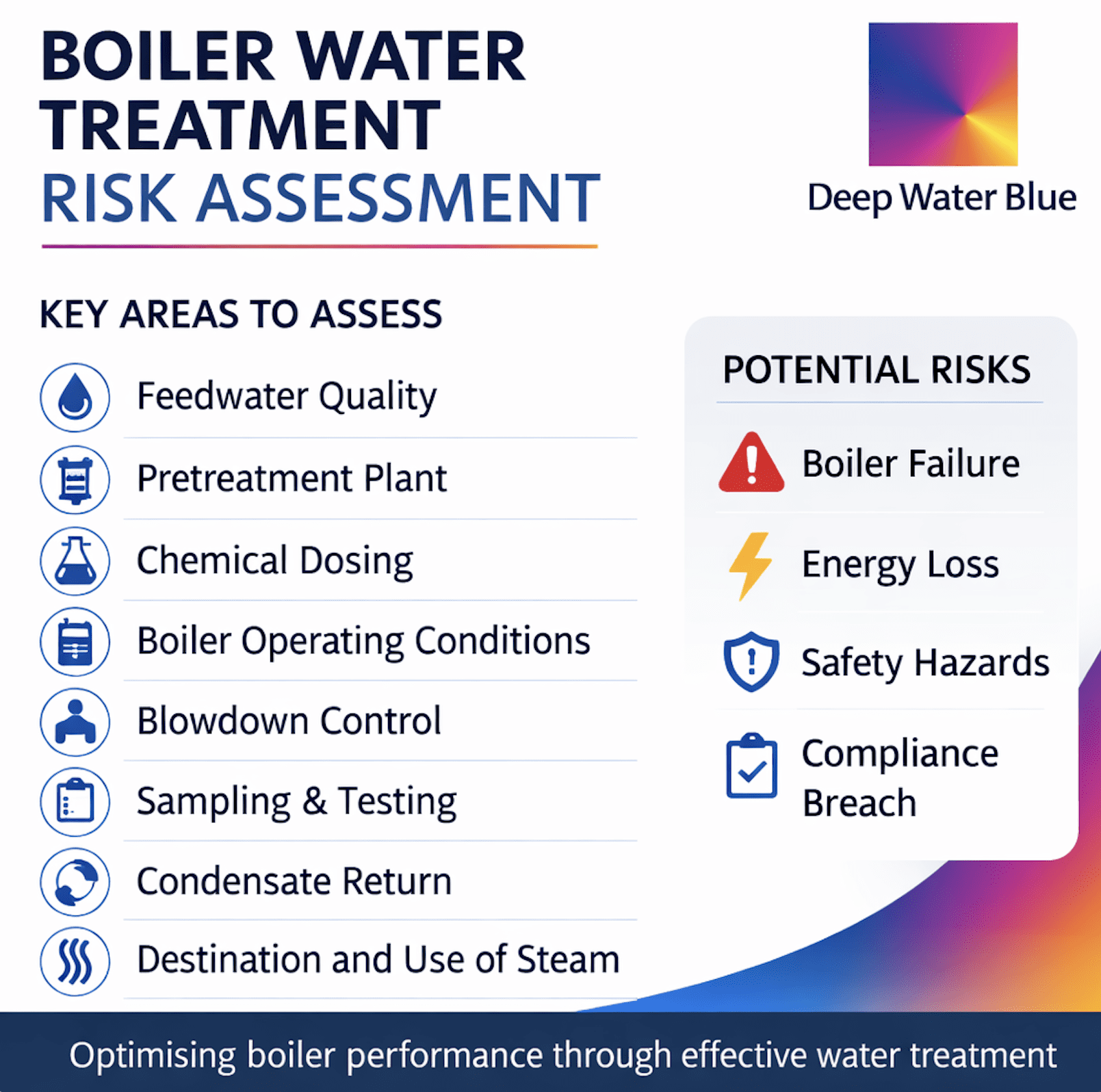
What Should a Boiler Water Treatment Risk Assessment Include?
A comprehensive assessment should cover all aspects of the steam system, including:
- Incoming water quality and pretreatment systems
- Boiler chemical treatment programmes
- Water testing regimes and monitoring points
- Operator training and competence
- Blowdown control and solids management
- Risk of contamination or steam carryover
By addressing these areas, organisations can proactively manage risks and maintain compliance.
Benefits of a Boiler Water Treatment Risk Assessment
Implementing a robust risk assessment delivers several key benefits:
- Improved boiler safety and compliance
- Increased energy efficiency and reduced fuel costs
- Extended equipment lifespan
- Reduced unplanned downtime and maintenance costs
- Protection of critical assets and personnel
Supporting Your Boiler Compliance
At Deep Water Blue, we support organisations across the UK in carrying out boiler water treatment risk assessments and compliance reviews.
Our expertise helps ensure your systems are safe, efficient, and aligned with industry best practice.
Because effective water treatment isn’t just about performance — it’s about protecting people, plant, and long-term reliability.