Top 10 Causes of Boiler Water Failure in UK Industry
Steam boilers remain at the heart of UK industry—supporting manufacturing, food production, healthcare, and energy systems. Despite advances in boiler design and control systems, one issue continues to undermine performance, efficiency, and reliability:
Boiler water failure.
From scale and corrosion to carryover and tube failure, poor water management is still one of the leading causes of unplanned downtime across UK sites.
Modern steam systems operate under increasingly demanding conditions—higher pressures, higher temperatures, and tighter efficiency targets. These systems rely on a delicate balance of chemistry, heat transfer, and operational control. When that balance is lost, failure is inevitable.
At Deep Water Blue, we work closely with engineering teams across the UK. The same root causes appear time and again.
Below, we outline the top 10 causes of boiler water failure—and what you can do to prevent them.
1. Inadequate Feedwater Treatment
Feedwater quality underpins the entire boiler system. If dissolved solids, hardness, or contaminants are not removed before entering the boiler, they will accumulate under high-temperature conditions and form scale or sludge deposits. These deposits significantly reduce heat transfer efficiency and can lead to overheating of metal surfaces. In high-pressure systems, even trace impurities can have a disproportionate impact, making robust pre-treatment systems such as reverse osmosis or demineralisation essential. Poor maintenance of the treatment plant or incorrect system design often leads to gradual deterioration that goes unnoticed until performance is affected.
2. Incorrect Chemical Dosing
Internal chemical treatment is a dynamic control process, not a one-time setup. Chemicals such as phosphates, oxygen scavengers, and alkalinity adjusters must be carefully balanced to maintain stable boiler conditions. Overdosing can lead to foaming and carryover, while underdosing leaves the system vulnerable to corrosion and scale. The challenge for many UK sites is maintaining consistency—manual dosing or lack of feedback control often results in fluctuating chemistry. Effective dosing requires accurate monitoring, responsive control systems, and a clear understanding of system demand.
3. Scale Formation
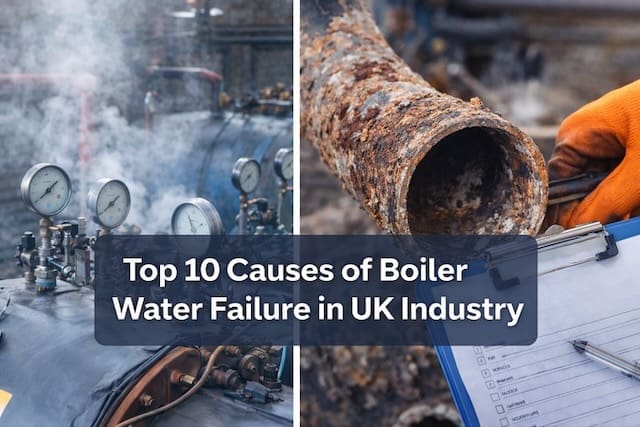
Scale forms when dissolved minerals—primarily calcium and magnesium—precipitate under heat and adhere to boiler surfaces. Even a thin layer of scale acts as an insulating barrier, reducing heat transfer and forcing the boiler to operate at higher temperatures to maintain output. This increases fuel consumption and creates localised hot spots that can ultimately cause tube failure. Over time, scale also contributes to flow restriction and uneven heat distribution, compounding the risk of mechanical stress and damage.
4. Oxygen Corrosion
Dissolved oxygen is one of the most aggressive corrosion drivers in boiler systems. When oxygen enters the system—typically through poor deaeration or system leaks—it reacts with metal surfaces to form pits. These pits can rapidly deepen, leading to tube perforation and failure. Feedwater systems, economisers, and condensate lines are particularly vulnerable. Effective control requires both mechanical deaeration and chemical scavenging, supported by continuous monitoring. Even small lapses in control can result in significant long-term damage.
5. Poor Blowdown Control
Blowdown is essential for maintaining acceptable levels of total dissolved solids (TDS) within the boiler. If TDS levels rise too high, the risk of foaming and carryover increases; if too low, energy and chemically treated water are wasted. Many systems still rely on manual blowdown, which introduces variability and inefficiency. Automated blowdown systems based on conductivity provide a far more reliable approach, ensuring that TDS levels remain within optimal limits and supporting both efficiency and steam quality.
6. Foaming, Priming, and Carryover
Foaming and priming occur when boiler water becomes unstable due to high TDS, oil contamination, or improper chemical balance. This instability allows water droplets to be carried over with the steam, leading to contamination of downstream systems. Carryover can damage turbines, foul heat exchangers, and compromise product quality—particularly in industries such as food and pharmaceuticals. These issues are often symptoms of deeper control problems and should be addressed through improved chemistry management and monitoring.
7. Poor Condensate Return Quality
Condensate is often treated as a clean and valuable resource—but in reality, it can be a significant contamination pathway. Process leaks, corrosion products, and oil ingress can introduce impurities into the condensate system, which are then returned to the boiler. This reintroduces contaminants into the cycle, increasing the risk of scaling, corrosion, and fouling. Effective condensate management requires monitoring, filtration, and, where necessary, diversion of contaminated streams to protect the boiler.
8. Inadequate Monitoring and Control
You cannot manage what you do not measure. A lack of real-time monitoring is one of the most common contributors to boiler water failure. Without accurate data on parameters such as conductivity, pH, and dissolved oxygen, operators are effectively working blind. Issues often develop gradually and only become visible once damage has occurred. Modern systems should incorporate continuous monitoring, automated control, and data trending to enable proactive management and early intervention.
9. Poor Water Circulation and Thermal Stress
Effective circulation is critical to maintaining uniform temperature distribution within the boiler. As outlined in fundamental steam generation principles, circulation ensures that heat is evenly transferred and prevents localised overheating. When circulation is impaired—due to blockages, design limitations, or operational issues—hot spots can develop. These lead to thermal stress, material fatigue, and ultimately tube failure. Circulation issues are often overlooked but can have severe consequences if not addressed.
10. Lack of Training and Operator Awareness
Even the most advanced boiler systems rely on knowledgeable operators. Water treatment is frequently underestimated, yet it requires a strong understanding of chemistry, system behaviour, and operational control. Without proper training, issues such as incorrect dosing, poor blowdown practices, and missed warning signs become more likely. A well-trained team is one of the most effective safeguards against boiler water failure, enabling proactive management and informed decision-making.
+Why This Matters for UK Industry
Modern steam systems operate under increasingly demanding conditions, with higher pressures, tighter efficiency targets, and greater scrutiny on emissions and energy use. At the same time, businesses face rising energy costs and net-zero commitments.
Boiler water failure is no longer just a maintenance issue—it is a critical business risk affecting efficiency, reliability, and compliance.
The Deep Water Blue Approach
At Deep Water Blue, we take a system-wide view of boiler water treatment. Failures are rarely caused by a single issue—they are the result of interconnected weaknesses across treatment, control, and operation.
Our approach focuses on:
- Risk-based water treatment strategies
- Real-time monitoring and control
- System optimisation across the full steam cycle
- Operator training and ongoing support
Final Thoughts
Boiler water may be out of sight—but it should never be out of mind.
Every inefficiency, failure, or unplanned shutdown can usually be traced back to water quality and control.
For anyone involved with steam boiler plant, the message is clear:
Treat boiler water as a critical asset—not a background utility.