The Most Overlooked Asset in the Boiler House: Is Your Feedwater Tank Working Against You?

When we think about steam boiler water treatment, attention naturally turns to the boiler itself. We consider water quality, chemical treatment, dissolved solids, blowdown and the risks associated with scale and corrosion.
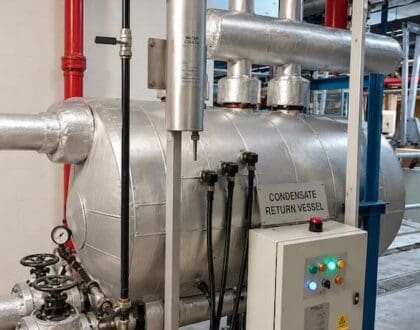
Yet one of the most influential pieces of equipment in the entire treatment process is often overlooked: the boiler feedwater tank, sometimes referred to as the hotwell.
Its role extends far beyond providing a reservoir of water for the boiler feed pumps. The condition, design and operation of this tank can have a direct impact on dissolved oxygen levels, chemical consumption, feedwater quality, energy efficiency and ultimately the working life of the boiler.
A well-managed feedwater tank supports effective boiler water treatment. A poorly managed one can undermine it before the water even enters the boiler.
More Than Just a Storage Tank
The feedwater tank is where several important elements of the steam system come together.
It receives make-up water, usually following some form of external water treatment, and returned condensate from the steam distribution system. Depending on the installation, it may also receive recovered flash steam or other heat sources.
These different water sources can vary considerably in temperature and chemical composition.
The tank therefore has several important functions:
- Maintaining an adequate supply of feedwater.
- Providing an opportunity to heat the incoming water.
- Helping to reduce the concentration of dissolved gases.
- Allowing make-up water and condensate to mix.
- Providing a suitable location for certain chemical treatment arrangements.
- Supporting stable feedwater pump operation.
Problems arise when these functions are taken for granted rather than actively managed.
Temperature: One of the Most Important Measurements
One of the primary reasons for heating boiler feedwater is to reduce its dissolved oxygen content.
Oxygen is a significant contributor to corrosion in boiler and feedwater systems. When dissolved oxygen is present, particularly in combination with unsuitable water chemistry, it can encourage localised corrosion and pitting.
These pits may be small, but they can become deep enough to compromise metal integrity.
As water temperature increases, the amount of oxygen it can hold decreases. Correctly designed heating and deaeration arrangements help release dissolved gases so that they can escape rather than being carried into the boiler.
For many conventional atmospheric feedwater tanks, temperatures around 80–90°C are commonly used, although the correct operating conditions depend on the system design and treatment regime.
The critical point is that a temperature reading alone does not guarantee effective deaeration.
Where is the temperature being measured? Is the water thoroughly mixed? Are cold areas developing within the tank? Is there an effective route for released gases to escape?
A tank showing an apparently satisfactory temperature on its gauge may still be sending poorly conditioned water to the boiler.
The Problem With Poor Mixing
Consider a feedwater tank receiving hot condensate and relatively cold make-up water.
If the incoming water is not introduced and mixed effectively, temperature stratification can occur. Hotter water may remain in one area while colder water passes towards the boiler feed pump suction.
This can increase the oxygen burden on the chemical treatment programme.
It may also mean that the temperature displayed on the tank does not accurately represent the water entering the boiler.
The introduction points for make-up water and condensate, the position of heating arrangements and the location of the feedwater outlet all influence performance.
A review of feedwater tank operation should therefore consider the physical arrangement of the system, not just the recorded temperature.
Chemical Treatment Cannot Compensate for Everything
Chemical oxygen scavengers are commonly used as part of boiler water treatment programmes.
However, the performance and consumption of these chemicals are influenced by the quality and temperature of the feedwater entering the system.
When the feedwater tank is operating below its intended temperature, more dissolved oxygen may remain in the water.
This can increase oxygen scavenger demand and reduce the margin available for protecting the boiler.
Simply increasing the chemical dose is not necessarily the correct answer.
It may temporarily improve a test result while leaving an underlying mechanical or operational problem unresolved.
There is also the question of reaction time. The selected chemical, dosing location, feedwater temperature and time available before the water reaches vulnerable equipment all need to be considered.
Effective treatment requires the mechanical and chemical elements of the system to work together.
Condensate Return: Valuable, but Not Always Trouble-Free
Returning clean condensate to the boiler house offers significant advantages.
Condensate is generally hot and has already undergone the energy-intensive process of being converted into steam. Recovering it reduces make-up water demand, chemical consumption and the energy required to heat incoming water.
But returning condensate can also introduce challenges.
Changes in production, intermittent plant operation or poorly controlled returns may cause substantial temperature fluctuations within the feedwater tank.
There is also the possibility of contamination entering through the condensate system.
A sudden change in feedwater appearance, conductivity, pH or temperature may indicate a developing problem elsewhere on site.
The feedwater tank is therefore not simply a receiving vessel. It can also be an important early warning point for changes in the wider steam system.
What About Tank Condition and Maintenance?
Physical condition matters too.
Internal corrosion, sediment accumulation, damaged heating components, unsuitable vent arrangements and unreliable level controls can all affect performance.
A tank operating at the correct temperature but containing significant corrosion products or debris is not providing ideal feedwater conditions.
Similarly, incorrectly positioned chemical injection points or damaged internal arrangements may prevent chemicals from mixing and reacting as intended.
Routine inspection and maintenance should be appropriate to the tank’s design, risks and operating conditions, with safe isolation and access procedures followed.
Five Questions Worth Asking
A useful starting point is to ask:
- Is the feedwater tank consistently operating at its specified temperature during normal and changing loads?
- Is the temperature measured at a location representative of the water entering the boiler?
- Are make-up water and condensate being mixed effectively?
- Have chemical dosing arrangements been reviewed against the current operating conditions?
- Is the tank inspected and maintained as part of the wider boiler water treatment programme?
If the answers are uncertain, the feedwater tank deserves further attention.
Looking Beyond the Boiler
A steam boiler is not an isolated piece of equipment. Its condition is influenced by the quality of water delivered to it and by the performance of the systems around it.
Even an effective chemical treatment programme can struggle when the feedwater tank is not operating as intended.
Reviewing tank temperature, mixing arrangements, condensate return, chemical injection and mechanical condition can identify opportunities to improve protection, reduce unnecessary chemical consumption and support long-term reliability.
At Deep Water Blue, we believe effective boiler water treatment starts well before the water enters the boiler.
If your feedwater tank has not been reviewed recently, or if you are experiencing unexplained corrosion, chemical consumption or fluctuating feedwater conditions, our specialist team can help assess how the different elements of your steam system are working together.